


Case Study: Inquiry-Based Learning Program in Taiwan
Six junior high and high school students from Shimane Prefecture, Japan, took on their first inquiry-based learning program in Taiwan.
These students were already actively engaged in inquiry-based learning projects in their hometowns.
Each student came to Taiwan with specific goals and interests.
One student explained:
"I'm working on a project to attract tourists to my hometown through the renovation of old buildings, so I want to learn about Taiwan's renovation culture."
Another student shared:
"I'm involved in marine environmental conservation activities in Japan, and I would like to meet organizations working on similar environmental issues in Taiwan."
The Japanese organizers also had a clear educational vision.
They wanted to provide local students with opportunities for "glocal education" — combining global perspectives with local understanding — through experiences beyond their familiar communities and national borders.
With these goals in mind, they asked our company to design and coordinate a customized inquiry-based learning program in Taiwan.
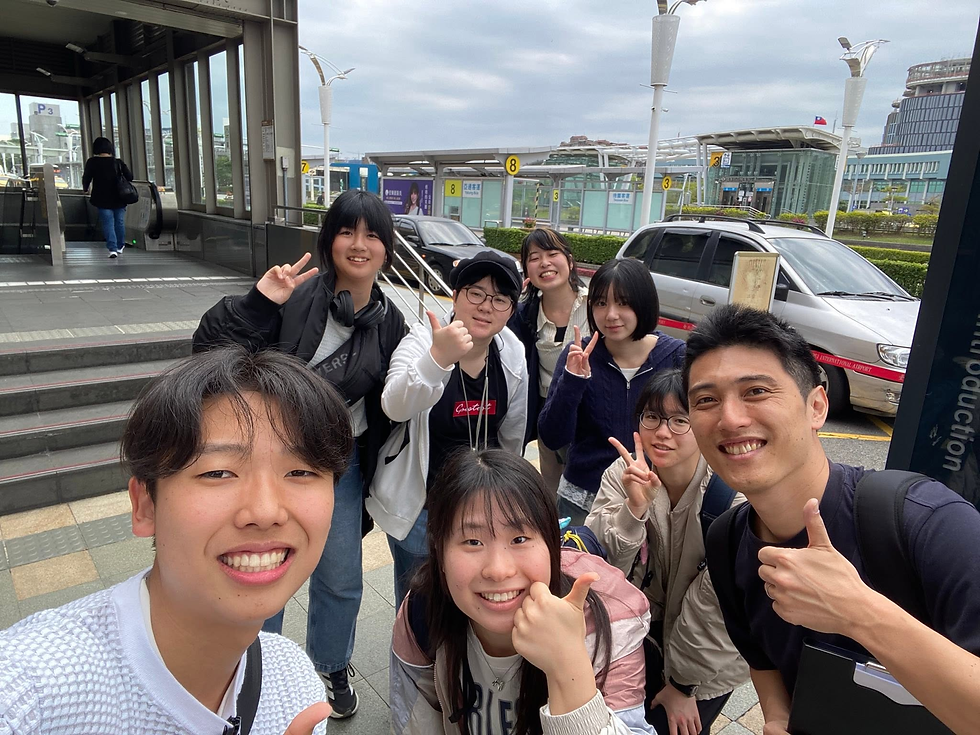
Table of Contents
Day 1 | Arrival and Orientation
After arriving at the airport, the group traveled directly to Taichung by Taiwan High Speed Rail.
We designed this four-day inquiry-based learning program primarily around Taichung.
There was a special reason for choosing this city.
A graduate of the students' school was currently studying at a university in Taichung.
The organizers hoped that meeting a former student who was already studying abroad would inspire the younger students and help them discover new possibilities for their own futures.
With this in mind, we invited the graduate to participate in every stage of the program, from planning to implementation.
Orientation and Chinese Language Practice
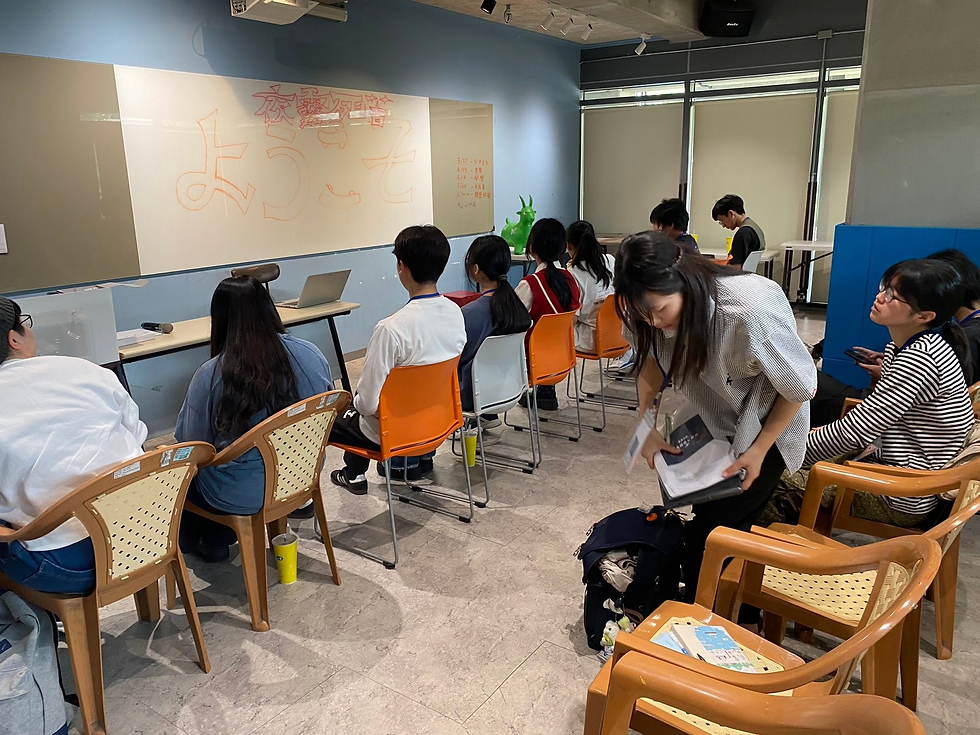
After arriving in Taichung, the students participated in an orientation session.
During this session, they reviewed the Chinese expressions they had studied before leaving Japan.
Why?
Because starting the very next morning, they had an important mission:
Buy their own breakfast using Chinese!
Rather than having breakfast arranged for them, the students would need to visit local shops and order food independently.
Knowing that they would have to use Chinese in a real-life situation, everyone practiced seriously.
Key Takeaway
When students have a clear purpose for using a foreign language, learning that language becomes much more meaningful.

Day 2 | Inquiry-Based Learning in Taiwan: Making Friends Across Borders
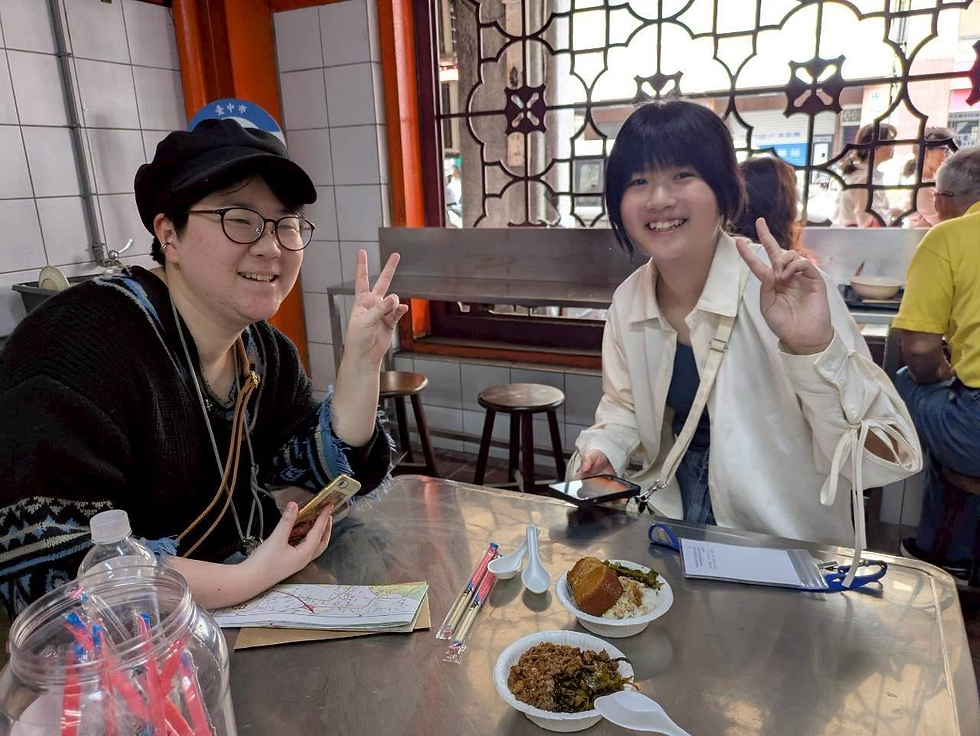
Buying Breakfast Independently Using Chinese
As announced during the previous day's orientation, the students were responsible for buying their own breakfast.
Their initial reaction was something like:
"Really? We have to do it ourselves?"
But once they gave it a try, their reaction quickly changed.
"We did it!"
After successfully ordering breakfast for the first time, the students gained confidence.
The following morning, they were able to buy their breakfast in Chinese again, this time with much less hesitation.
Key Takeaway
Once students successfully use a foreign language in a real-life situation, they gain the confidence to use it again.
Experiencing a University Class in Taiwan (2 Hours)
This marked the beginning of the main inquiry-based learning activities.
We visited a university in Taichung, where the Japanese students joined a Japanese conversation class attended by Taiwanese university students.
For native Japanese speakers, it is not every day that they have the opportunity to see how people from other countries learn Japanese.
During the class, the Japanese students were encouraged to communicate using Easy Japanese — simplified Japanese designed to be easier for non-native speakers to understand.
However, knowing what makes Japanese easy to understand is surprisingly difficult for native speakers.
To prepare for this experience, we had introduced the concept of Easy Japanese during the orientation on Day 1.
Using Japanese textbooks designed for foreign learners, the students explored what kinds of words and expressions are easier to understand.
They also practiced speaking in simpler Japanese.
Thanks to this preparation, conversations with the Taiwanese university students went smoothly!


Visiting a Taiwanese High School (2 Hours)
In the afternoon, we visited a high school in Taichung.
For this exchange, we deliberately selected an alternative school.
Like the visiting Japanese students, students at this Taiwanese school place a strong emphasis on inquiry-based learning.
We arranged for students from both countries to present the research topics and projects they were working on.
The Japanese students introduced their own inquiry-based learning projects, while the Taiwanese students shared their research and experiences.
This gave both groups an opportunity to discover how students in another country approach similar educational challenges.
Key Takeaways
resenting their research projects overseas allows students to share their own ideas while learning about different approaches and perspectives in Taiwan.
Key Takeaways
Students also discover that meaningful communication is possible even without perfect language skills.

Day 3 | Inquiry-Based Learning in Taiwan: Learning from a Graduate Studying Abroad
Study Abroad Experiences Shared by a School Graduate (2 Hours)
There was one particularly important reason we chose Taichung for this program.
A graduate of the participating students' school was studying and building a new life there.
Having a role model from one's own school is extremely valuable.
However, students rarely have the opportunity to sit down with a graduate and hear their experiences in detail.
We therefore arranged a special session in which the graduate shared their experiences of studying at a Taiwanese university.
The students had many questions.
"Why did you choose to study in Taiwan?"
"What is university life abroad really like?"
"Wow, I never imagined studying abroad could involve so many unexpected challenges!"
The graduate spoke openly about the experiences, difficulties, and discoveries of studying overseas.
Hearing these firsthand stories gave the younger students a more realistic understanding of international education and the possibilities available to them.
Key Takeaway
Meeting a relatable role model can inspire students to imagine new possibilities for their own futures.

Taichung Fieldwork Challenge (6 Hours)
The main event of the program was a six-hour fieldwork challenge in Taichung.
Students explored the city while completing a series of missions.
The objective was to reach the final destination by successfully completing the assigned challenges along the way.
Each group consisted of two Japanese students accompanied by one Taiwanese university student.
The Taiwanese university students served as local buddies, supporting communication and encouraging interaction throughout the activity.
Exploring the City with a Mission Sheet
Each group received a mission sheet containing a series of challenges to complete.

There was one important rule:
The Japanese students were not allowed to use smartphones.
Instead, they had to navigate the city using paper maps.
The students had to explore their surroundings carefully, identify the correct location, and work together to complete the task.

They visited different places at their own pace and completed the missions listed on their instruction sheets.

One of the challenges was:
"Find a traditional guardian lion-dog statue in Taiwan and take a photo!"
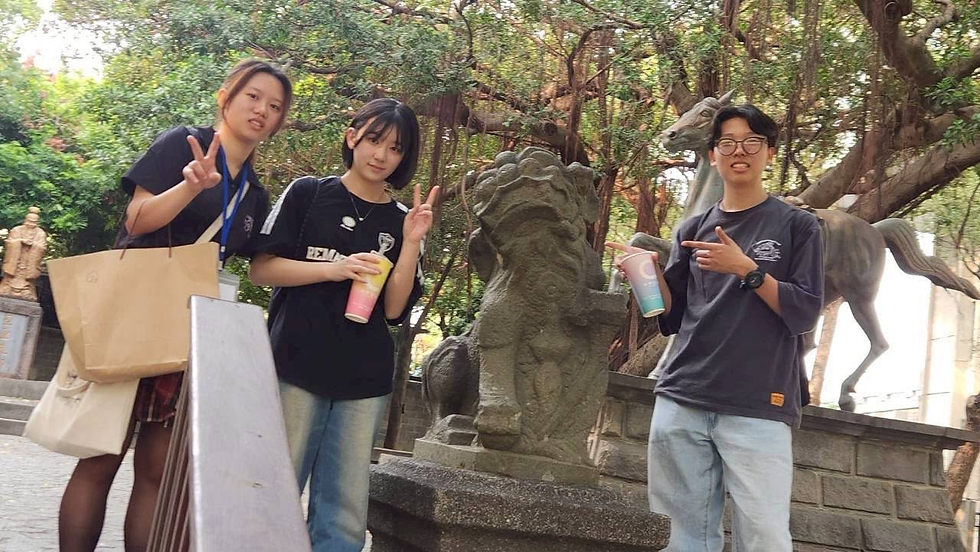
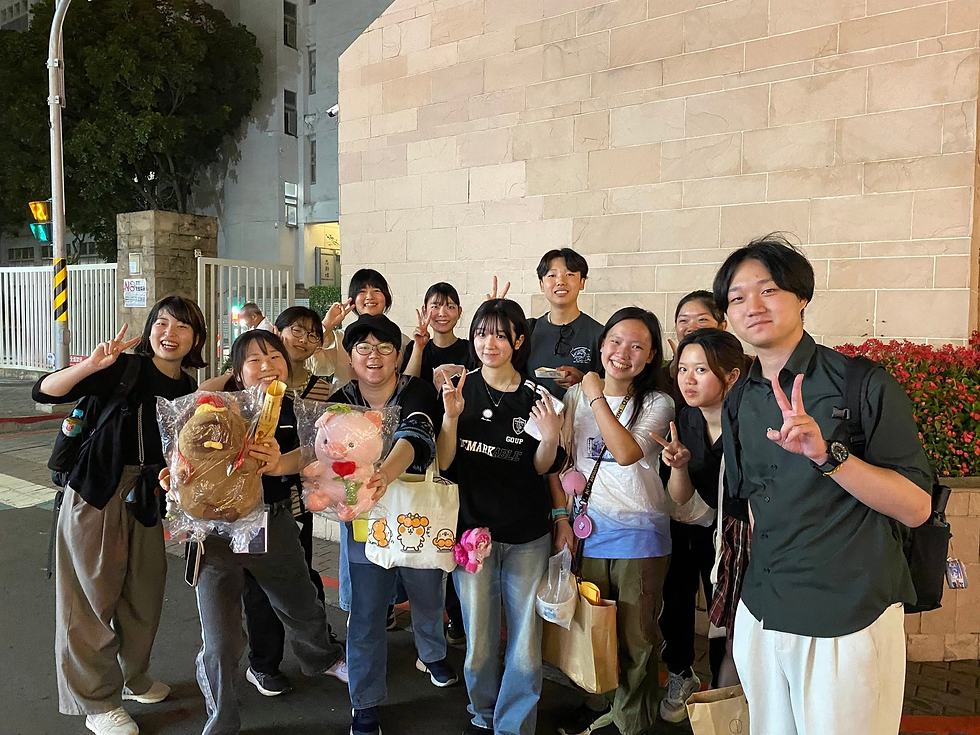
Eventually, all groups successfully reached the final destination!
Connecting Fieldwork with Students' Research Interests
The fieldwork missions were not simply sightseeing activities.
We carefully incorporated locations related to the students' individual inquiry-based learning projects.
For example, one student was researching how renovating old buildings could help attract tourists to their hometown.
We therefore included places where students could observe Taiwan's approach to preserving and reusing historic buildings.
Another important theme was understanding the historical and cultural connections between Japan and Taiwan.
We selected locations where students could discover evidence of the long-standing relationship between the two countries.
By exploring independently and completing missions, students experienced Taichung through all five senses.
They encountered local culture, geography, everyday life, and the people who live there.
Rather than simply listening to explanations, they learned by actively engaging with their surroundings.
Key akeaway
Combining hands-on learning with intercultural communication allows students to learn through direct experience, using all five senses.
Day 4 | Inquiry-Based Learning in Taiwan: Exploring Regional Challenges
Visiting Two Organizations Addressing Local Social Issues
One of the participating students was conducting research on marine environmental conservation.
Before the trip, the student had expressed a specific request:
"I would like to meet people in Taiwan who are working to address environmental issues."
To respond to this interest, we arranged visits to organizations working on environmental and regional revitalization challenges.
Visit 1: Tackling Food Waste and Supporting People Experiencing Homelessness
Our first visit was with Ms. Yang, a social entrepreneur based in Taichung.
She works to reduce food waste while supporting people experiencing homelessness.
Her initiative collects surplus food that would otherwise be discarded and uses it to prepare meals at a restaurant.
Revenue generated from the restaurant helps fund programs supporting people experiencing homelessness as they work to rebuild their lives.
By connecting environmental sustainability with social welfare, her work demonstrates how a business can address multiple social challenges.
After listening to Ms. Yang's story, the Japanese student researching environmental issues seemed deeply inspired.
It was as though a new passion had been awakened.

Visit 2: Regional Revitalization in Lukang, Changhua
Our second visit took us to Lukang, a historic town in Changhua County.
There, we met Mr. Chang, who is actively involved in regional revitalization.
His work focuses on developing sustainable businesses that preserve local culture while creating economic opportunities.
One of his goals is to encourage young people who have left their hometowns to return by creating attractive employment and business opportunities.
While enjoying Lukang's famous steamed meat buns, the students listened to Mr. Chang explain his initiatives and the challenges facing local communities.

Both Ms. Yang and Mr. Chang are actively involved in addressing regional and social challenges in Taiwan.
For the Japanese students, meeting practitioners working directly on these issues was an invaluable experience.
They were able to hear real stories from people taking action to improve their communities.
Key Takeaway
Learning directly from people who are addressing real-world challenges provides insights that cannot be gained from textbooks alone.
Farewell Gathering with Taiwanese University Students
After completing the main program, the group spent its final evening in Taichung with the Taiwanese university students who had accompanied them throughout the activities.
These university students had supported the Japanese participants during school visits, fieldwork, and other exchange activities.
The farewell gathering was an opportunity to reflect on their shared experiences and celebrate the friendships they had developed.
Then came a wonderful surprise.
The Taiwanese university students had prepared gifts and handwritten letters for their Japanese friends.
They had organized everything entirely on their own initiative.
The Japanese students were deeply touched.
After spending three days together, this thoughtful gesture showed just how meaningful their connections had become.
It was a moment that reminded everyone that international exchange is ultimately about people and the relationships they build.
ポイントKey Takeaway
International exchange is not only about crossing national borders. It is about creating meaningful connections between people.
These personal connections can become the foundation for developing future glocal leaders who understand both their local communities and the wider world.


Day 5 | Final Day: Exploring Taipei and Returning Home
Traveling to Taipei and Enjoying Sightseeing
On the final day, the group traveled from Taichung to Taipei.
After four days of intensive learning, cultural exchange, and fieldwork, it was time to enjoy some traditional sightseeing.
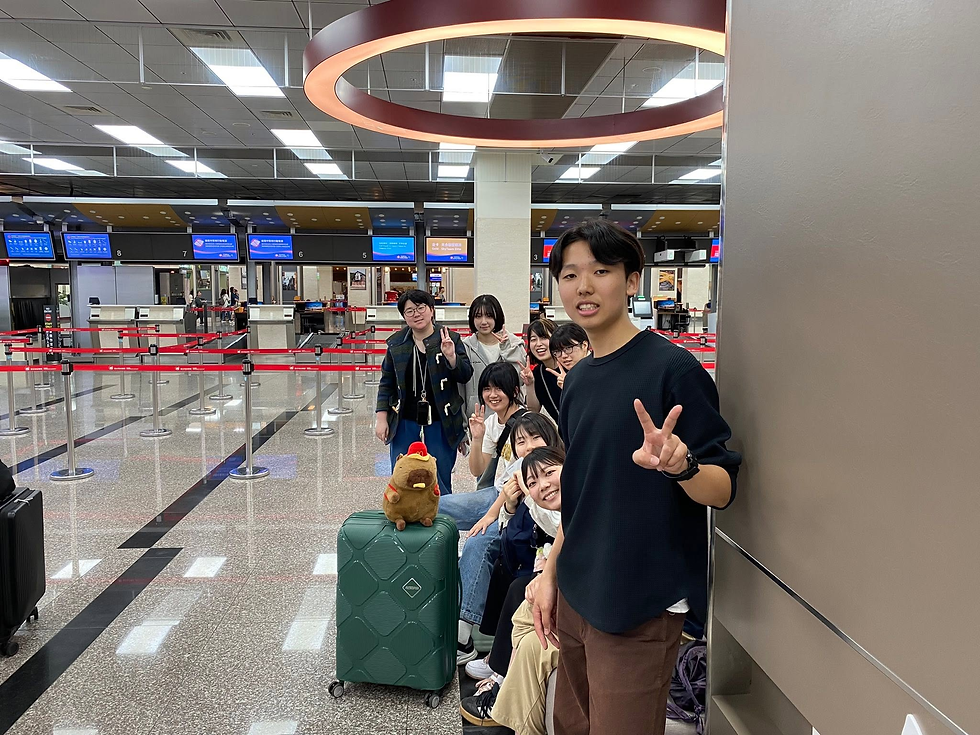
The students explored Taipei before heading to the airport for their return flight.
The five days had passed incredibly quickly.
Key Takeaway
Overseas educational programs provide powerful opportunities for students to experience new environments, gain fresh perspectives, and learn through all their senses.

Why We Recommend Educational Programs Beyond Taipei
Many Japanese schools choose Taipei as the main destination for their school trips and overseas educational programs.
However, our company can coordinate educational exchanges and learning programs throughout Taiwan, not just in Taipei.
Taiwan's regional communities face many of the same social challenges as those in Japan.
These include population decline, the outflow of young people, and the concentration of economic opportunities in major cities.
Because of these shared challenges, many local communities in Taiwan are enthusiastic about welcoming students from Japan.
International educational exchanges create valuable opportunities for students and communities in both countries to recognize the challenges they share.
They can also become the starting point for new collaborations, mutual learning, and long-term relationships.
By visiting regions outside the capital, students can discover different aspects of Taiwanese society and gain a deeper understanding of the country.
Why not consider exploring Taiwan's regional communities for your next educational exchange program?
We would be happy to help you design a customized learning experience that connects your students' interests with the people, communities, and challenges of Taiwan.


Comments